
Sensory changes appear 5-15 years before dementia
Tracking in your 40s can add years to your life
The Checklist That Could Save Your Mind
Most people don’t know this, but your brain’s health depends on your senses. This free checklist reveals the 10 essential secrets you need to stay sharp.

When multiple senses decline moderately..
1 in 2 die within 5 years
Most people have no idea it's happening.
We adapt and compensate while moderate decline quietly damages our brain.
The risk shows up early
Smell decline: 5-15 years before diagnosis
Hearing/vision: 10+ years before diagnosis.
Multi-sensory decline:
exponential risk

50% of decline is missed
We adapt.
We compensate.
We miss the signal.
Your doctor already knows:
Audiologist know hearing affects brain health.
Ophthalmologist know the same about vision.
ENT's, about smell and taste.
But they don't talk to each other.


All 5 senses
1 measurement system
Track changes annually.
Act while interventions are simple.
Get ahead of decline.
Loved ones: Catch what they miss.
This isn't about preventing future Alzheimer's.
This is about protecting performance today.
The Signal Everyone Misses
Large-scale studies (BMC 2025, Pinto 2017) reveal that moderate (not total loss) hearing and vision loss raise mortality risk stepwise, accounting for ~11% of deaths.
The window:
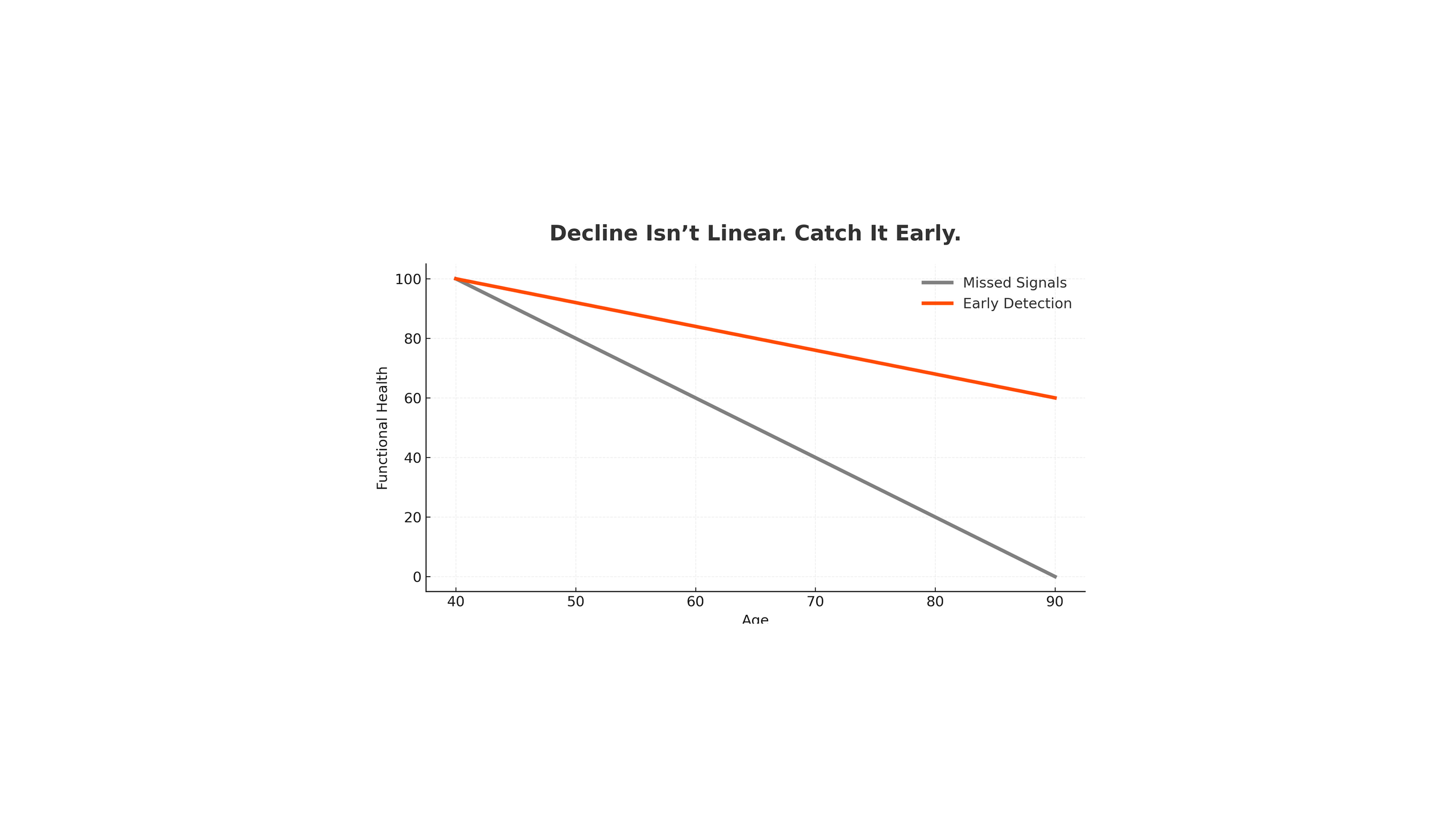
Sensory decline follows a predictable curve.
When tracked early, intervention can flatten the slope—protecting focus, independence, and longevity.


Your Brain's First Vital Sign
Smell, taste, hearing, vision, and touch change years before memory does. We make those signals measurable.
How Does It Work?
1. Start with The Kit
Guided tests for smell, taste, vision, hearing, and touch.
2. Check In Annually
Use it at home, with family, or in a group.
3. Track Changes
Track shifts you won't notice on your own.
Half of sensory changes go undetected without testing.
4. Act Early
Small fixes today protect your brain for years.

Protect your mood, focus, and longevity

Built by scientists. Backed by research. Ready for you.
Our protocols are built by top researchers from Johns Hopkins and Columbia. Every test is grounded in peer-reviewed science—simple enough to do at home, powerful enough for use in clinical studies.
Bring SuperSenses to Your Community
Early changes in smell and hearing are often the brain’s first quiet signals that something is shifting. We should be tracking those senses as routinely as blood pressure or cholesterol—and tools like SuperSenses finally make that kind of at-home tracking realistic, so we can pay attention to changes long before more obvious symptoms appear.
Dr. Sita Kedia, MD, MPH, FAHS
Chief Medical Officer, PALM Health
"If cognition is the next vital sign, SuperSenses monitors the pre-vital signs — the sensory shifts that warn us before cognition is measurable.
Dr. David Libon, PhD
Neurocognitive Researcher
Loss or decrements of smell function can be harbingers for early mortality, as well as numerous debilitating diseases and disorders.
Dr. Richard L. Doty, PhD
University of Pennsylvania
The Latest Science

No One Cares About Old People
The Fitbit for your brain. Your entire brain's purpose is to process sensory information. That's its job all day long. When the senses degrade, the brain loses its ability to stay sharp.
Are We Just Measuring Decline, or Actually Helping People?
Most sensory decline goes unnoticed until it’s too late.



At-Home Sense Tests Backed by Research and Developed by Doctors

The sense of smell is often one of the earliest indicators of cognitive decline, including conditions like Alzheimer's disease. Changes in your ability to detect odors can occur before other symptoms, making it a critical marker for early detection. Regularly testing your sense of smell can provide early warnings of cognitive health issues.
Test Method: We use the 12-Odorant Scratch & Smell Test to evaluate your ability to detect and identify various odors. This test provides valuable insights into your olfactory function, helping you monitor changes over time.


"I saw multiple specialists because I thought I was losing my sense of taste. No one tested my sense of smell—until SuperSenses showed me that was the real issue."
Mel - SuperSenses User
Frequently Asked Questions
Have questions? Let's chat
Drop us a message — we’re here to answer questions and point you in the right direction.